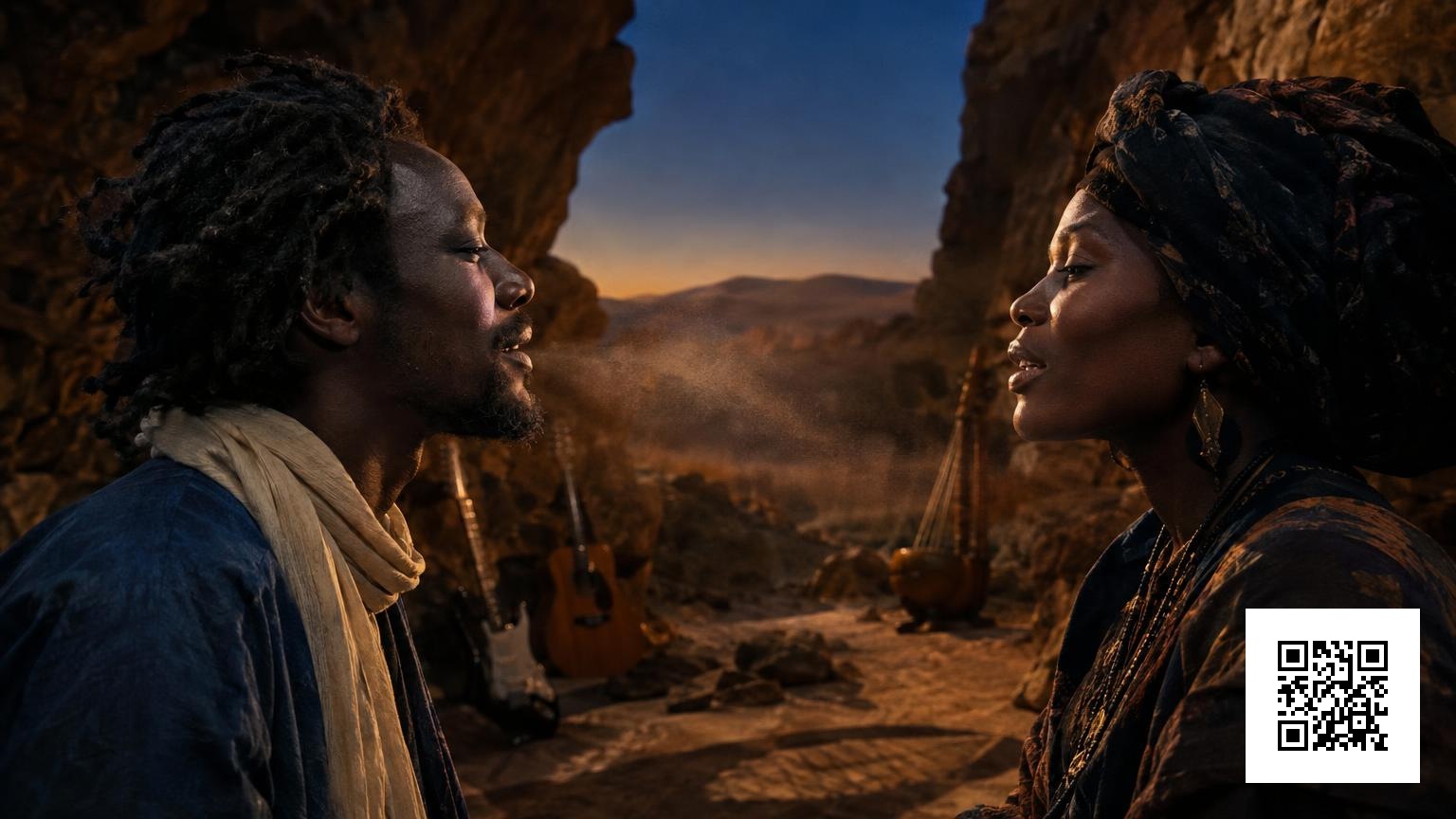
Echoes of the Gorge places two equal Tamasheq voices in a compact call-and-response at 88 BPM. Short lines move back and forth: one voice states, the other answers, and occasional French and Sahelian refrains puncture the duet without replacing Tamasheq as the lead language.
Travel, memory and endurance sit at the song’s centre. The arrangement keeps instrumentation sparse so the twin vocals remain the focus: pentatonic guitar riffs and kora-like harp textures weave above a steady percussive bed while the voices complete each other in tight cycles.
Twin-voice call-and-response
Two voices share centre stage and neither yields lead status. Exchanges are short and exact rather than long and wandering. That compression makes every reply count and creates a kind of vocal choreography where silence and space are part of the phrase.
Repetition measures the form. Motifs recur in slightly altered shapes so the duet builds recognisable cycles rather than open solos. Listeners hear pattern as structure: a line, a reply, a return, each time with a small shift that makes the next landing feel inevitable.
Language and refrains
Tamasheq is the thread that runs through the whole piece. French and other Sahelian phrases appear at moments that feel public facing, short refrains that widen the address beyond the duet while keeping the Tamasheq cadence intact.
Because French appears as a brief reply or chorus, the track allows bilingual recognition without shifting its vocal centre. For another example of Tamasheq with French woven into replies see Tamasheq, French and the Sahel in Sands of the Route.
Pulse, guitars and percussive bed
The organising pulse sits at 88 BPM and sets a steady midtempo pace. That tempo spaces each exchange so a phrase can echo before the next begins, a useful restraint when two voices converse continuously.
Instrumentation is deliberately spare. Pentatonic electric and acoustic guitar phrases repeat while kora-like harp textures float above them. Calabash and frame drum rhythms supply the percussive bed. The result keeps the arrangement open and the twin voices prominent; for a track that chooses different tempo and lead arrangement see Night Sand Lullaby: a 64 BPM Sahel lullaby from Niger.
Where it sits on Afrikana Best Sounds
Echoes of the Gorge appears inside the Desert Voices strand on Afrikana Best Sounds alongside Akal n Tament, Ténéré Pride and Desert Reunion. Those siblings share the Desert Blues label and the Tamasheq, French and Sahelian language mix, but each finds its own balance between voice and instrumental space.
Placed beside Night Sand Lullaby and Assouf of the Dunes, the differences become clear. Night Sand Lullaby foregrounds a single lead with whispered replies and a slower pace, while Assouf of the Dunes runs at a slightly higher midtempo with more instrumental spread. Echoes of the Gorge is distinct because it foregrounds a strict twin-voice dialogue at 88 BPM. For navigation across related writing see Heart of Africa : tous les articles and for the free listening tools try L'application AFRIKANA.
Desert Blues (Tishoumaren / Assouf)
Desert Blues, labelled here as Tishoumaren or Assouf, is the style assigned to Echoes of the Gorge on Afrikana Best Sounds and to other Desert Voices titles. It occupies a clear place in Sahelian music where steady midtempo pulses and Tamasheq vocal forms recur across radio playlists.
Origins and development
Tishoumaren and Assouf emerge from Sahel and Sahara traditions shaped by nomadic movement and long-distance travel. On Afrikana Best Sounds these styles collect under the Desert Voices strand where Tamasheq vocals meet French refrains and Sahelian phrases.
Defining traits
The style favours a steady midtempo pulse and call-and-response vocal forms. Instrumental traits present in Echoes of the Gorge include repeated pentatonic guitar phrases, kora-like harp textures and calabash/frame drum rhythms. Vocals prefer concise lines and repetition rather than extended soloing.
How this track fits or bends the style
Echoes of the Gorge fits the Assouf label through its desert imagery, its 88 BPM organising pulse and its repetitive motifs. It bends the familiar by giving two equally prominent voices tight, cyclical exchanges instead of a single extended lead, which narrows the arrangement and keeps attention on vocal interplay.
That narrowed frame shifts emphasis from instrumental flourish to verbal exchange and underlines themes of travel and endurance. For listeners curious about neighbouring strands, try Assouf of the Dunes, a 92 BPM Tamasheq Desert Blues on Afrikana Best Sounds.
Neighbouring styles to explore next
Palm-Wine Guitar and West African Soul sit nearby on Afrikana Best Sounds as contrasting strands that sometimes share French and Sahelian phrases while offering different rhythmic frameworks. Those styles change the pulse and instrumental language while keeping lyrical links intact.