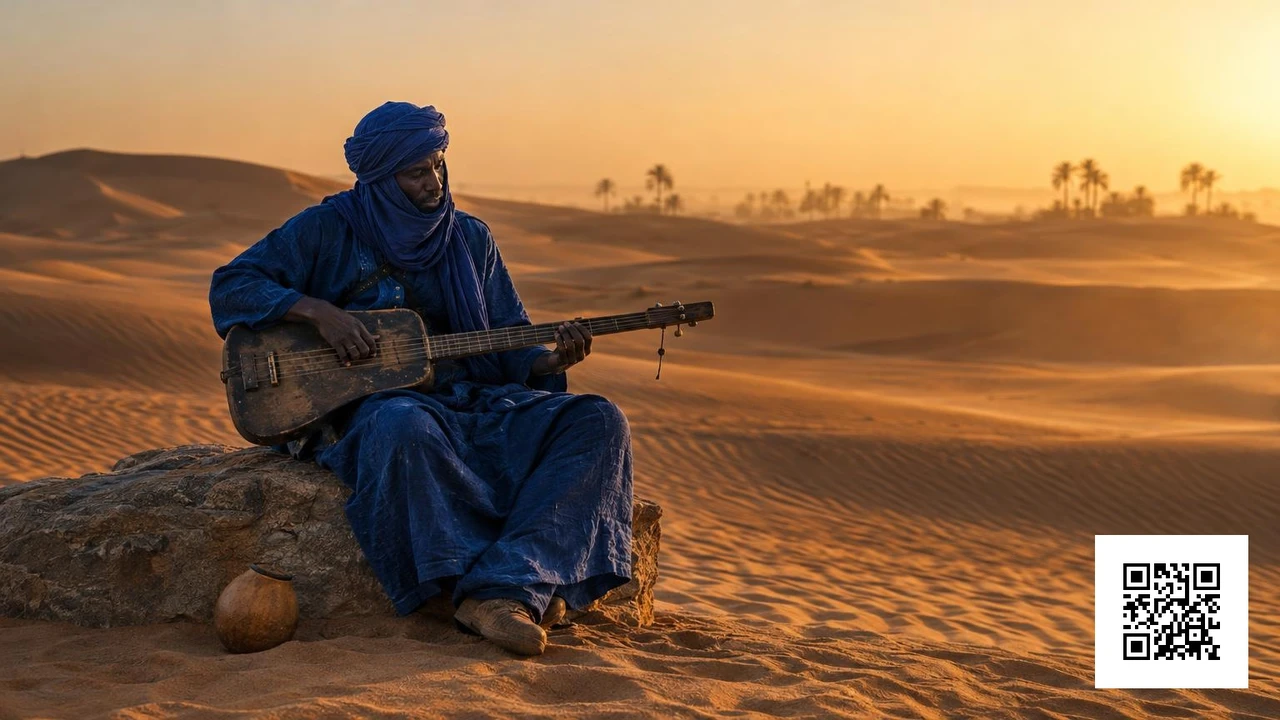
Assouf of the Dunes runs at 92 BPM and sets that midtempo as its organising pulse, spacing repeated pentatonic slide phrases and call-and-response lines in Tamasheq. The original title names Hypnotic Slide Guitar & Pentatonic Call, and that pairing guides the track’s foreground.
The voice is mostly Tamasheq with short French refrains folded into the chorus. A kora-guitar hybrid texture and resonant slide guitar share the foreground while sparse Saharan percussion, calabash strokes and handclap patterns keep the rhythm open. The arrangement favours space and repetition, and it carries a particular palate I call « Le goût de ça » (the taste of that).
92 BPM desert pulse
Ninety-two beats per minute is the track’s organising number. That pace leaves room for a slide phrase to recur between vocal lines and for small timing shifts to register: a motif held a moment longer, a calabash stroke arriving just after a vocal phrase.
Percussion stays minimal. Handclap patterns mark phrase endings and soft calabash strokes add texture rather than propulsion. The result is a measured groove that feels deliberate, almost meditative, while still allowing the pentatonic motifs to hypnotically repeat.
Slide guitar and kora-guitar hybrid
Pentatonic riffs and a warm, resonant slide guitar form the melodic anchors. Those motifs return between vocal statements and shape the chorus’s contour, moving in small increments rather than broad leaps.
Beneath the slide, a kora-guitar hybrid provides a harp-like harmonic bed that keeps the sound open. The arrangement leaves air around each plucked figure and each slide phrase, so every return feels like a fresh event rather than a background loop.
Tamasheq lines, French refrains
Lead lines arrive in Tamasheq and the chorus answers, with brief refrains in French folding into the responses. French does not take over narration; it appears as a counterpoint that slightly shifts where emphasis sits in the chorus.
The call-and-response places the solo voice against a communal reply. That structure names nostalgia, exile and longing: Tamasheq carries the primary statements, French echoes them in short refrains, and together they set the song’s emotional frame.
Where it sits on Afrikana
On Afrikana Best Sounds Assouf of the Dunes belongs to the Desert Voices cluster alongside Ténéré Pride, Desert Reunion, Ténéré Tabbalt and Talagh. Each shares the Tishoumaren or Assouf style tag, but they differ in language mixes and in how string textures and percussion are balanced.
Assouf distinguishes itself by its explicit 92 BPM pacing and by folding French refrains into a primarily Tamasheq track. Some related pieces list additional sahélian languages, or keep Tamasheq alone; others alter the rhythmic emphasis or the density of the kora-guitar hybrid bed. See the related feature Ténéré Voices, a Sahel hymn in Tamasheq for a close example, or browse all Heart of Africa articles to compare. For playlists and curated sequences, check all playlists and if you want the single on your phone use the AFRIKANA app.
Desert Blues (Tishoumaren / Assouf)
Desert Blues, labelled here Tishoumaren or Assouf, sits in Nigerien Tamasheq practice where lead singing meets repeated slide motifs and restrained percussion. On Afrikana Best Sounds this style appears under Desert Voices and often returns to themes of travel, exile and communal memory.
Origins and development
The style rises from Tamasheq vocal practice across the Sahel and Sahara. Solo lines that invite group reply have long been central; over time those vocal forms paired with sustained slide approaches and sparse percussive patterns to hold lyrical themes about movement, return and homesickness in desert settings.
Defining traits
Tracks in this family commonly use pentatonic riffs, slide guitar phrasing and call-and-response vocals. Arrangements favour a kora-guitar hybrid texture alongside soft calabash and handclap patterns, and leave generous space around voice and repeating motifs.
Tempo sits in a midrange that supports repetition and trance. In this case the pace is 92 BPM and the mood is described as hypnotic, nostalgic and meditative.
How this track fits or bends the style
Assouf of the Dunes follows the style’s blueprint: alternating a solo Tamasheq line and an answering chorus while centring pentatonic slide motifs. It inserts short French refrains as replies rather than a main narrative voice, and it favours a sparse bed where slide and the kora-guitar hybrid share the foreground.
Those choices give it a particular balance of language and texture inside the Desert Voices cluster and set it apart from siblings that either keep only Tamasheq or list extra sahélian languages.
Styles to explore next
If you want neighbouring sounds on Afrikana, try pieces that foreground different plucked approaches or alter the rhythmic pocketing. Small changes to the string texture or to percussive density show how the placement of Tamasheq singing changes across the repertoire.