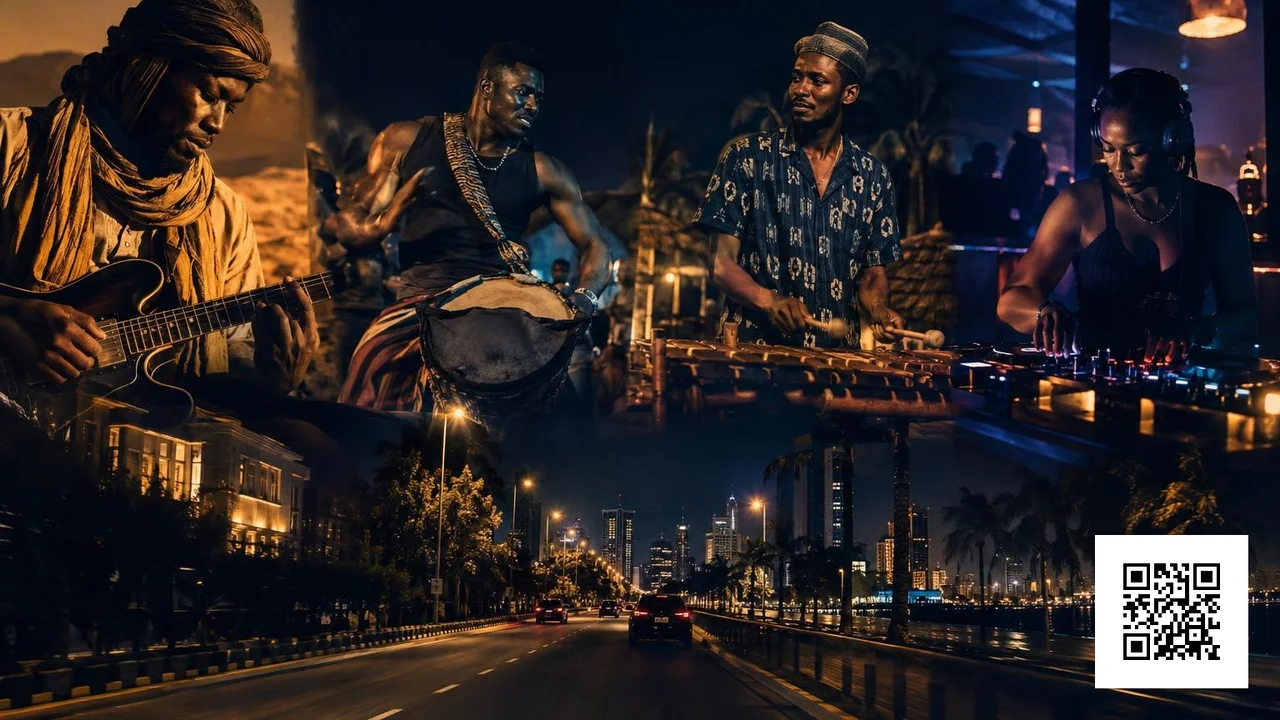
African Night Drive is presented as a smooth night drive experience that gathers Afrobeats, Alté and Afrohouse into one sequence of late-night songs. The playlist description frames city lights and long roads and asks for a focused ear on tempo, language and the textures each track brings to the route.
 ▶ Listen to the full playlist on YouTube
This guide follows the four featured titles in the playlist order and points out what to listen for: the pulse numbers given in each record, the languages sung, the named textures such as slide riffs, sabar percussion, Tekno underlayers, balafon touches and a techno bass, and how vocals are arranged as lead lines or call-and-response. Read each chapter in sequence to hear how the night shifts from a 92 BPM desert blues opening to 112 BPM club pulses.
Listen to the full African Night Drive playlist on YouTube and in the AFRIKANA app. For navigation among related mixes see All playlists or browse more writing at Heart of Africa : tous les articles. Le goût de ça (the taste of that) arrives when the groove clicks and the road opens.
Desert Reunion
Desert Reunion is listed at 92 BPM and sung in Tamasheq and French. The record is described as a warm, guitar-driven Desert Blues single built around hypnotic slide riffs and a call-and-response vocal architecture. The stated theme is reunion and celebration across the dunes, which the arrangement supports by keeping tempo measured and deliberate.
To listen in order, first locate the 92 BPM pulse that spaces every phrase. Then follow the slide riffs as they recur and reshape the melodic ground. Vocals arrive as a lead line in Tamasheq calling and a chorus answering, with French moments folded into the replies. The interaction between slide guitar and group voice is the track’s organising gesture: repetition becomes the hook and the chorus marks the communal moments.
Because the piece holds a midtempo beat while foregrounding voice and guitar, it sets the playlist’s opening tone and opens a Sahel-centered frame. If you want another close read of a similar steady midtempo organising voice and chorus, see How 88 BPM shapes Talagh.
Ndoto za Pesa
Ndoto za Pesa runs at 112 BPM and uses English and Swahili. The record is tagged as Amapiano, Afrobeat and Techno Street Africaine with the declared theme of easy money. Its mood words are energetic, intense and hypnotic, so the track inhabits the playlist’s club-forward register.
Listen for how bilingual vocals become part of the rhythmic surface. English and Swahili lines are delivered inside a 112 BPM grid so phrasing and cadence act like percussion. The style labels suggest a blend where Amapiano rhythmic patterns meet Afrobeat motion and a techno street edge. Repeated vocal hooks lock with the beat and act as rhythmic markers rather than long narrative lines.
Placed after the Desert Blues opener, this song shifts the night into urban momentum and raises tempo to a danceable band. For a continuous mix in the Amapiano and Afrohouse vein, consult the Afrobeats Amapiano longplay.
Ñu xool, ñu wutt, ñu gën
Ñu xool, ñu wutt, ñu gën is sung in Wolof and set at 112 BPM. The description places it as a pounding Afropop–Afro Techno street rally that pairs intense sabar percussion with a fast Tekno underlayer. The theme is a party among friends, an affirmation of group and collective energy.
Start by isolating the percussive insistence. Named sabar percussion supplies sharp syncopated attacks while the Tekno underlayer keeps a continuous bed beneath the vocal lines. Wolof vocals arrive as short, affirmative calls that land on top of those textures; their repetition makes the voice act as both message and rhythmic instrument.
The mood tags given are rapid, powerful, euphoric and very danceable. In the playlist sequence this track raises energy toward a street and club crossroads where traditional percussion and electronic pulse meet. For another high-energy Wolof dance reference, try MBALAX AFTERPARTY, Wolof Dance Energy.
Nguvu Ya Mikono
Nguvu Ya Mikono is sung in Swahili and is identified as coming from Zanzibar, Tanzania. The style is described as Amapiano and Afrobeat with a nocturnal beat that includes African percussions, a techno bass and a light balafon. The stated theme is labour, a tribute to hands that build through the night.
Listen for the contrast the record names: a low techno bass underpins forward motion while a light balafon colours the high register and percussive elements push the groove. Swahili vocal lines ride that bed and the described mood is lively, driving and ironic. The arrangement carries dignity of work inside an upbeat nighttime rhythm rather than a slow lament.
Positioned at the sequence end of these four titles, the song reconnects club textures with an East African nocturnal focus. If the Tanzanian label draws you, the Bongo Flava Tanzania longplay offers more of that urban East African pulse.
Afrobeats Alté Amapiano
The playlist title gathers Afrobeats, Alté and Afrohouse while the featured tracks show Amapiano, Afropop and Sahel Desert Blues registers at work. Collectively they map an evening that moves from guitar-led desert celebration to club-aligned Amapiano pulses and percussive Afropop.
Where the style comes from
The featured records locate themselves in night settings named by the playlist: streets, clubs and communal gatherings. Desert Reunion sits in a Sahel Desert Blues frame with slide guitar and call-and-response chorus. Ndoto za Pesa and Nguvu Ya Mikono state Amapiano and Afrobeat ties for urban and nocturnal contexts. Ñu xool brings regional percussion and Tekno elements into an Afropop rally that bridges street and dancefloor.
Defining traits described
Tempo across the four titles is given as either 92 BPM or 112 BPM, so the flow moves from a measured midtempo to sharper dance pulses. Vocals appear in Tamasheq, French, English, Swahili and Wolof and the tracks repeatedly use call-and-response or group affirmation as structural devices. Textures named in the records include slide guitar riffs, sabar percussion, a Tekno underlayer, light balafon touches and a techno bass. These elements create contrasts between acoustic lead colours and electronic low-end motion.
How these tracks fit or bend the style
Desert Reunion leans toward Desert Blues and keeps voice and guitar central at 92 BPM rather than pushing to the club. Ndoto za Pesa and Ñu xool live on the faster 112 BPM side where Amapiano motion, Afrobeat phrasing and Tekno or techno street edges accelerate the night. Nguvu Ya Mikono sits between both worlds: balafon and African percussions meet a nocturnal techno bass to create an Afrobeat/Amapiano hybrid that names labour while remaining danceable.
Styles to explore next
If Desert Blues and Tamasheq voices drew you, follow more pieces in that register that centre slide guitar and chorus replies. If the 112 BPM push appeals, dive deeper into Amapiano and Afropop tracks that combine electronic beds with regional percussion. To collect and share what you like, use the AFRIKANA app to stream and save favourites or open All playlists to continue the night.
▶ Listen to the full playlist “African Night Drive | Afrobeats • Alté • Afrohouse” on YouTube