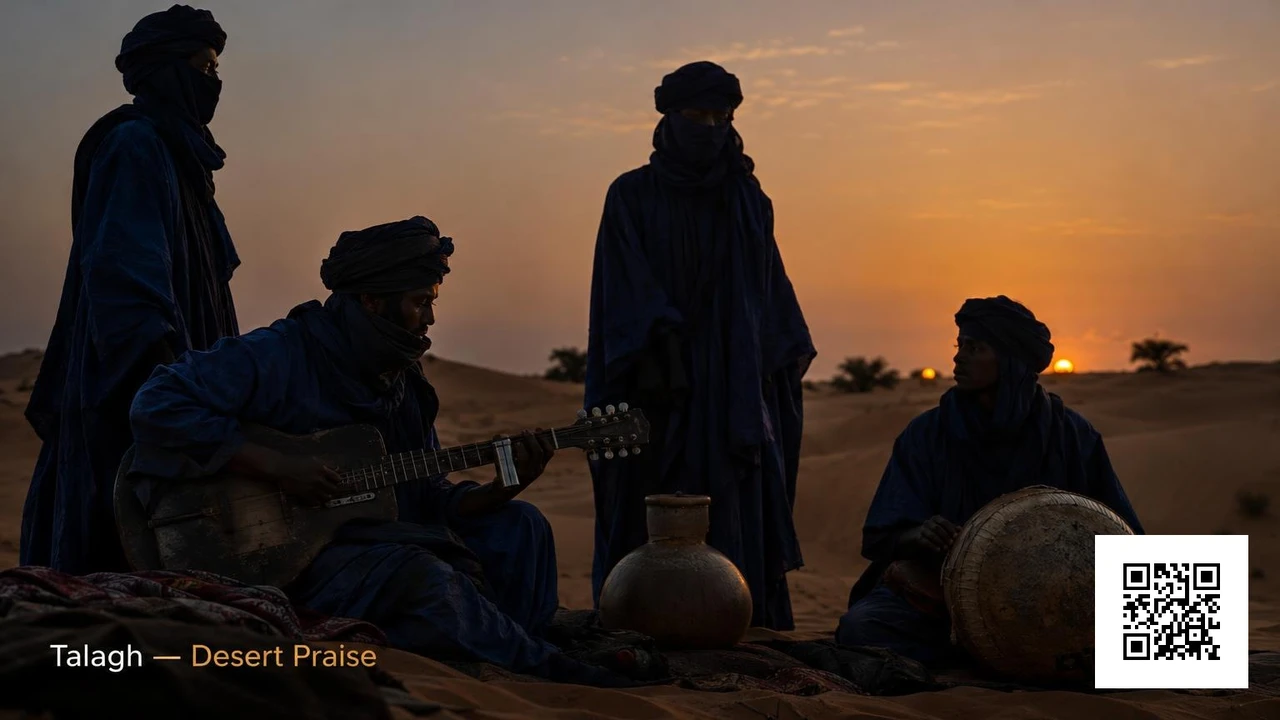
Talagh opens at 88 BPM. That steady midtempo is the track's organising pulse: it spaces each Tamasheq line and French refrain so the call-and-response lands like a deliberate breath.
The song is described as a hypnotic Desert Blues hymn of gratitude, where pentatonic slide phrases, a kora-guitar hybrid and tende pulses form a meditative, uplifting backdrop.
The 88 BPM heartbeat
88 BPM becomes audible from the first phrase. The tempo gives long vocal turns time to arrive and to be answered; nothing must hurry and nothing floats free of that measured step.
Phrases in Tamasheq unfold across the beat. At this speed the lead voice can hold notes and slide into answers; the chorus replies in the same frame, turning individual lines into communal statements. Talagh comes from Mali's Sahel region, and that local sense is audible in how the pocket supports communal singing.
For another Sahel hymn built around a clear pocket, see Ténéré Voices.
Language and layered praise
Tamasheq leads most of the singing, with French refrains appearing as close, intimate comments. The bilingual layout shapes who speaks and when: long Tamasheq calls, brief French echoes.
The theme is plain, praise, gratitude and communal blessing. Call-and-response is the form the words take; answers come not as afterthoughts but as part of the song's structure.
If you want a track that sets Tamasheq lines at its centre in a different tempo, try Azelik Rhythm.
Slide phrases, kora-guitar bed and percussive steps
Pentatonic slide-guitar phrases trace repeating shapes across the 88 BPM frame. A kora-guitar hybrid provides the harmonic bed while tende and lighter calabash pulses outline the rhythm.
The percussion sits low, like measured footsteps. At this speed the low pulses anchor the voice and the slides; they leave space for silence between replies and for listeners to find small moments of attention. The arrangement's measured pace matches the described mood: hypnotic, meditative and uplifting.
That quiet attention carries « Le goût de ça », the taste of that shared, brief thank you. For a different regional sound, the Taarab playlist offers another way into paced, reflective songs.
Who Talagh gathers
The hymn names land, elders and communal memory. Each blessing is placed into the pocket and held there until the chorus affirms it.
Talagh suits listening where attention is slow and collective: homes, gentle radio hours and shared moments of thanks. You can download and share it on L'application AFRIKANA, which provides free streams, nine webradios and a way to build and share playlists.
To explore more Heart of Africa coverage of Sahel hymns and language-led songs, see Heart of Africa : tous les articles.
Desert Blues / Tishoumaren (Assouf)
Desert Blues, also named Tishoumaren or Assouf, occupies Sahelian guitar traditions where extended vocal lines and pentatonic slide phrases meet regional percussion. Talagh places these traits inside an 88 BPM hymn framework.
Where it comes from
Tishoumaren and Assouf have roots in Tuareg and Sahel cultural spaces in Mali and neighbouring zones. The style privileges extended vocal lines, communal call-and-response and pentatonic guitar phrasing.
Defining traits
In this register you will find measured tempos, long Tamasheq vocal turns, pentatonic slide-guitar phrases and instruments that echo local playing traditions. In Talagh the tempo is 88 BPM, vocals sit forward and percussion is provided by tende and calabash pulses.
How this track fits
Talagh fits the Desert Blues label by foregrounding Tamasheq calls and group replies over slide phrases and a kora-guitar hybrid. The steady 88 BPM pocket shapes phrasing and keeps the arrangement meditative while the French refrains add intimate, public punctuation.
Neighbouring styles to explore
Nearby styles include Raï for North African vocal storytelling and Taarab for regionally rooted, ensemble songs; both offer different approaches to pace and communal singing.