Rhythm and how it moves the body
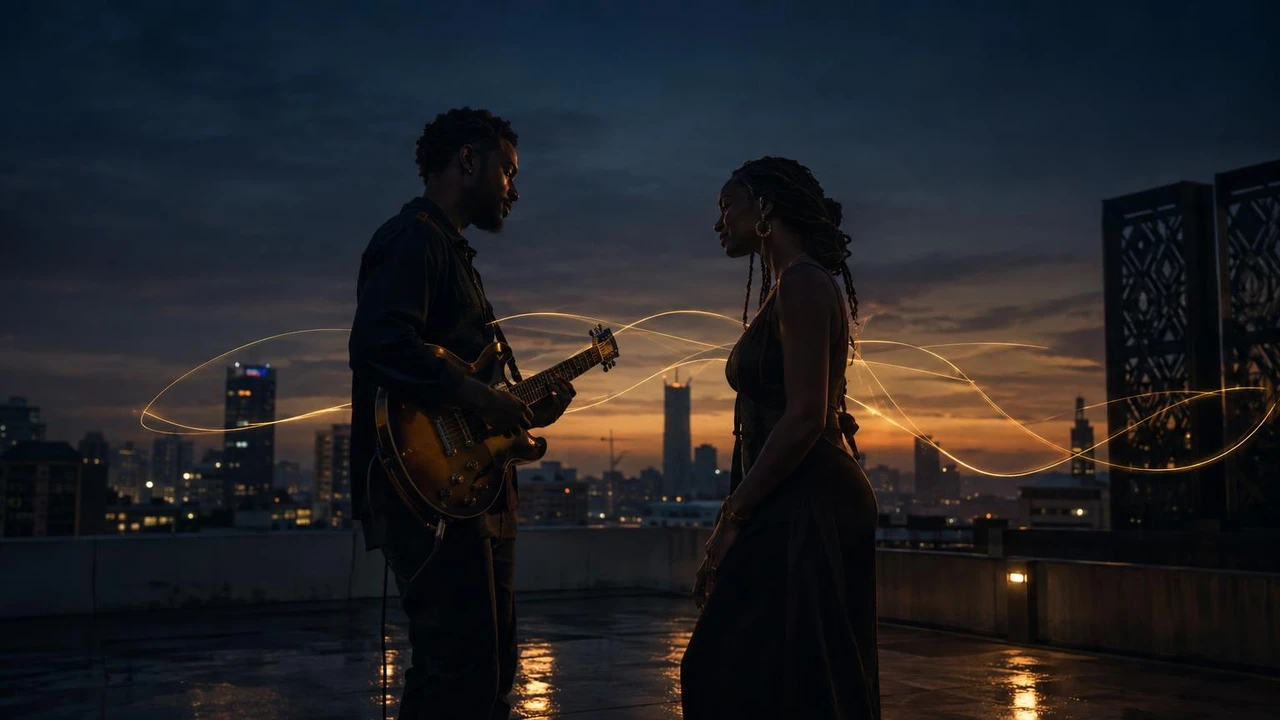
The pulse here is deliberate and intimate rather than driving. A soft late‑night groove keeps time — enough to sway the shoulders or rock the torso, not to push a crowd. Rhythm grows from the meeting of guitar placement and vocal timing: steady arpeggios set a heartbeat while the singers push, linger and slip around it, creating micro‑syncopations that invite slow movement.
Notice how vocal phrases arrive just before or after the guitar accents; those tiny delays open a hush where the body responds by breathing with the music rather than stepping out of it.
Instruments and their cultural roles
Highlife guitar
The guitar supplies the most recognisable material: harp‑like, interlocking lines that recall highlife phrasing. Arpeggios sit high in the mix, offering melodic threads and rhythmic punctuation. Instead of dominating, the guitar alternates between anchoring motifs and floaty voicings that leave air for the duet.
Guitar as conversational partner
Beyond melody, the guitar’s rhythmic placement clarifies the late‑night pulse. Fills and short responses to vocal phrases act like a second speaker in the conversation, giving the singers room to embellish and answer.
Language: French voice, Fongbé reply
The track is framed as a bilingual duet: French carries the lead lines with rounded vowels and a measured cadence that feels narrative, while Fongbé answers with a warmly shaped reply. The Fongbé parts function as call‑and‑response rather than literal translations — they reframe, colour or deepen the emotion of the French phrases.
For listeners who don’t know Fongbé, meaning emerges from tone, timing and where the reply resolves: the interplay of cadence and pitch does the storytelling work.
Region and tradition
Zinli contemporain appears here as a modern handling of regional melodic inflection and ornamentation, adapted to contemporary, ambient textures. Vocal micro‑ornaments and modal turns drawn from local practice are woven into a pared‑back arrangement.
Highlife guitar elements gesture to a West African lineage of interlocking electric and acoustic patterns, but the treatment is intimate rather than archival: melodic gestures are kept close to the voices and stretched into the song’s nocturnal space.
Energy, audience and listening tips
This recording is best heard in a quiet room. Headphones or nearfield speakers at moderate volume reveal tiny exchanges: the breathy head‑voice flickers, chest voice clarity, and the warm reverb that suggests night air.
Pay attention to moments when the Fongbé reply reframes a French line — those are the emotional pivots. The track suits late‑night listening, slow company, or solitary moments when music can act like a conversation partner rather than a backdrop.
Zinli contemporain × Afro‑Soul Nocturne
Zinli contemporain × Afro‑Soul Nocturne places regional West African melodic modes beside intimate contemporary soul phrasing. Within African music, Zinli contemporain updates local modal ornamentation for modern production while Afro‑Soul brings late‑night vocal closeness to contemporary arrangements.
Origins and development
Zinli contemporain is a modern reinterpretation of regional melodic modes and vocal ornamentation adapted to ambient production. Afro‑Soul in Africa channels global soul phrasing through local songcraft; highlife guitar supplies the harp‑like interlocking lines that inform much of the guitar language here.
Defining musical traits
Typically slow to mid‑tempo, the pulse is intimate rather than propulsive. Drums are understated—light kicks, rim clicks or brushed snares—while bass remains warm and supportive. Vocals favor close delivery, micro‑ornamentation and call‑and‑response; instruments centre on highlife‑style guitar, minimal keys and soft percussion.
How this track fits
This duet uses French lead lines answered in Fongbé, unfolding over highlife‑influenced, harp‑like guitar arpeggios and space‑filled voicings. The groove is a soft late‑night pulse: deliberate, intimate, with tiny vocal delays and small syncopations that invite slow, swaying movement. Production uses warm reverb, soft low‑end and gentle stereo width.
Styles to explore next
Highlife; Neo‑Soul.