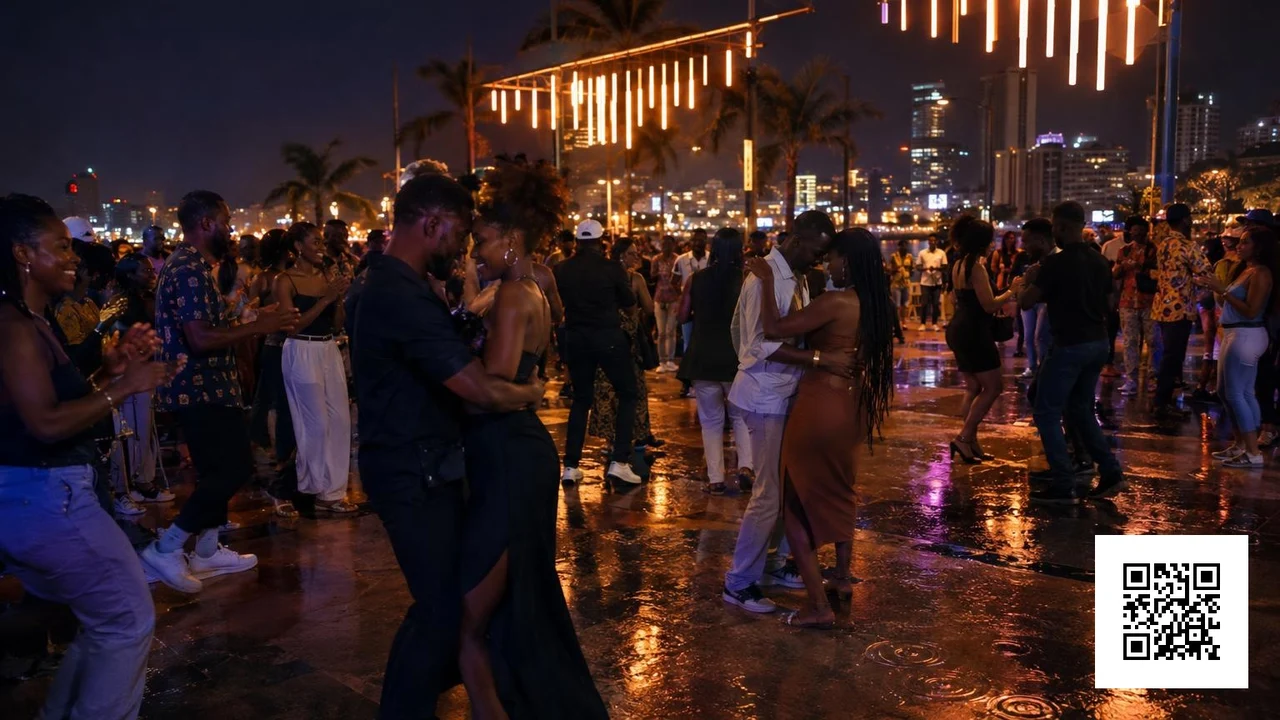
Teu Corpo Diz Tudo runs at 102 beats per minute and is sung in Portuguese as spoken in Angola, threaded with local street expressions. From the first bar marimba motifs and clipped claps set a steady sway that orients movement and speech in Luanda nights.
The arrangement places bright marimba figures above a pronounced low register and heavy bass. The song’s description calls it the heartbeat of Luanda and frames the track as a Kizomba born in the street, a mix of seduction, dance, freedom and urban energy.
102 BPM and the partner sway
At 102 BPM the pulse is a measured sway. That tempo gives partners time to lean close, to trade small, precise movements and to answer with a clipped vocal turn or a held silence. The pace is steady rather than driven; it keeps motion intimate and contained.
Pauses within the groove function as cues. Short gaps and rhythmic rests arrive like street signals: an invitation, a change of figure, a moment to respond. Le goût de ça, the taste of that, appears in these immediate exchanges where neither voice nor step needs to hurry.
Placed between faster club tempos and very slow ballads, 102 BPM sits in a practical middle. For context, other tracks move much slower or faster: compare the walking tempo of Wind Over the Dune's 64 BPM pulse or the insistence of 130 BPM Afrohouse pieces such as Beae no wɔ hɔ, 130 BPM Twi Afrohouse Challenge.
Marimba motifs and clapping foreground
Marimba figures recur as bright threads across the mix. They play short melodic hooks that ride above the beat, giving the top of the arrangement a clear, percussive melody that partners can read even in crowded rooms.
Claps cut through with sharp punctuation. Those clicks mark time and create readable accents that answer the marimba. Beneath both elements the record keeps a pronounced low register and heavy bass; the two-layer architecture is simple and effective, light melody over anchored weight.
The description places this sound in Luanda’s streets and even names a contemporary moment for it. That brightness over weight is one way the track signals its urban origin and its connection to city nightlife in Luanda.
Portuguese, Angolan inflection and street speech
The sung language is Portuguese with Angolan inflection and inserted street turns. Vocal lines move between longer sung phrases and short conversational bursts, so the voice slides from song to speech without losing the musical role.
Local expressions act as shorthand on the floor. They punctuate verses with quick calls that invite shouted answers or echoed replies, and they make the address unmistakably Luandan rather than generic Portuguese. For other pieces where language steers the song’s social address, see the Heart of Africa hub: Heart of Africa : tous les articles.
Luanda nights and who it speaks to
Everything in the arrangement points back to Luanda: urban weight, street-born melodic touches and a confident, sensual mood. The themes listed for the song are seduction, dance, liberty and urban energy; the production choices keep that list visible at every turn.
The track is pitched at people who meet to move together and trade bold signals on partnered floors or at pavement gatherings where small circles form and steps get exchanged. To place the song inside playlists and radio flows that follow this city sound, try the AFRIKANA app for radio and curated sets on mobile. L'application AFRIKANA
Urban Kiz / Afrobeat Kizomba
The track is labelled Urban Kiz and Afrobeat Kizomba, a hybrid that anchors Kizomba’s Angolan partnered tradition in contemporary urban club language. Teu Corpo Diz Tudo pairs a steady kizomba tempo with a heavy low end and street phrasing tied to Luanda.
Origins and development
Urban Kiz names a city-facing reworking of Kizomba’s Angolan roots, adapted for club environments and for urban streets where steps and speech intermingle. The Afrobeat qualifier points to a shared emphasis on low end and club-oriented rhythmic drive that travels across African urban scenes.
Defining traits
On this recording the defining traits are explicit. A strict 102 BPM pulse governs timing, recurring marimba motifs deliver bright melodic hooks, clipped claps supply rhythmic punctuation and a pronounced low register anchors the arrangement. Vocals are in Portuguese (Angola) with local street expressions, and the noted moods are modern, sensual and confident.
How this track fits or bends the style
Teu Corpo Diz Tudo follows the hybrid by prioritising close partnered movement and steady timing. It leans distinctly toward Luanda street energy by keeping marimba figures prominent and by favouring short, colloquial vocal turns rather than extended, sweeping runs. The result is a city-facing Kizomba that keeps one foot on the floor and the other in the crowd.
Neighbouring styles to explore
Listen to Kizomba sets alongside Afrobeat selections to hear how the partnered tradition sits next to broader club rhythms. For tempo contrasts, investigate slower, walking pieces and faster Afrohouse tracks to map where this hybrid lives in contemporary playlists.