Rhythm and the body's movement
Set at 72 BPM, the track trades urgency for a deliberate, breathing pace. The space between beats is a structural element: it gives syllables room to land and lets melodic lines extend across a single handful of pulses. That measured tempo asks for small, contained movement — a slow step, a nod, the inhalation that comes before a story is told aloud.
Rather than driving toward a peak, the pulse supports an unfolding. Pauses feel like counted rests in conversation; syncopations, when they arrive, are subtle nudges rather than surges. The result is a sway that invites close listening and small, embodied responses rather than full‑on dancing.
Instruments and their sonic roles
Balafon: woody, bell‑like commentary
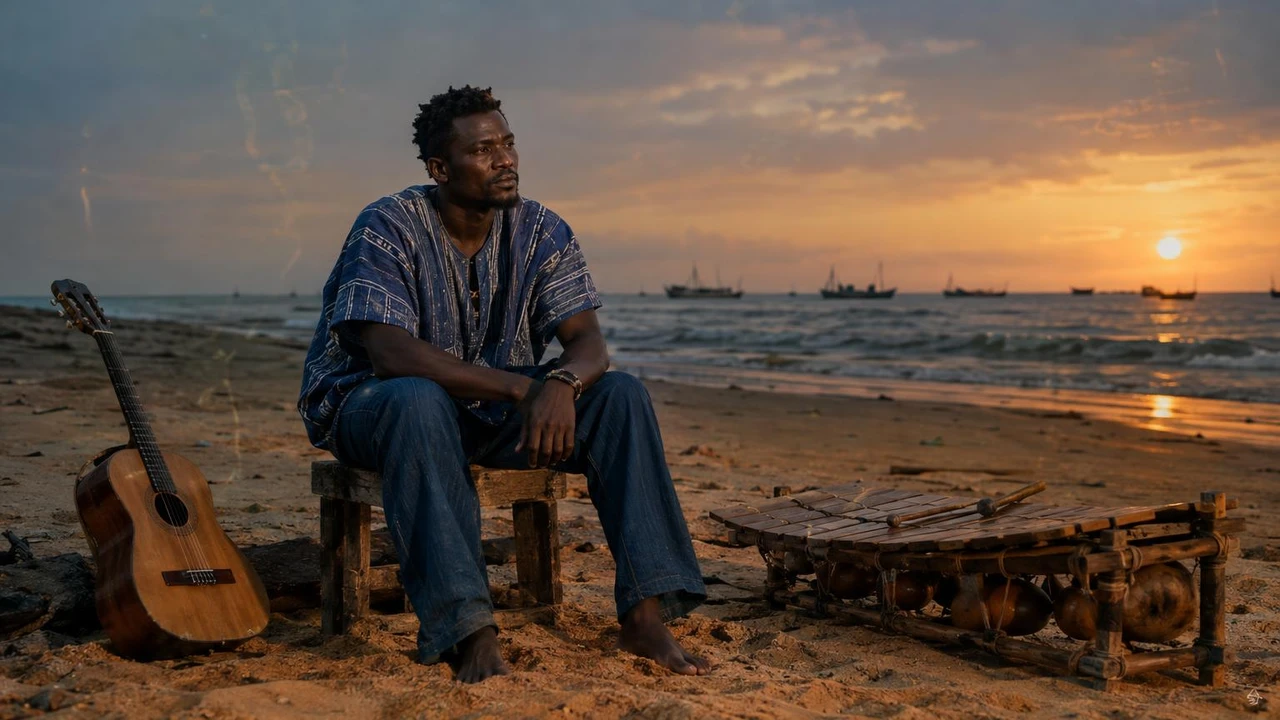
The balafon offers short, resonant strikes that sit just behind the voice. Its timbre — wooden slats with quick decay and a slight harmonic shimmer — punctuates phrases and answers vocal turns. It functions as a melodic percussion, marking emotional shifts and reinforcing the song’s tonal contours without overwhelming the singer.
Palm‑wine strings: intimate forward motion
Fingerpicked acoustic strings supply the harmonic and rhythmic thread associated with palm‑wine styles. The patterns are discreet: repeated figures that provide momentum and warmth, filling the lower midrange while leaving clear space for the voice and balafon. The strings keep the arrangement transparent and human-scaled.
Language as musical architecture
Long vocal passages in Fon and Ewe form the track’s narrative spine. Because both languages are tonal, pitch and inflection are integral to meaning; the melodies take their shape from the contours of the words. Listening to these sections is simultaneously linguistic and musical — the voice negotiates meaning while following or bending tonal expectations.
French appears in short, reflective lines that function like a pause for collective comprehension. Those moments compress sentiment into a briefer sound-space, offering a shift in register without interrupting the song’s flow. English refrains are even more concise: compact, direct addresses that extend the piece outward to listeners who might not follow Fon or Ewe but who are being explicitly included.
Region and tradition in sound
Anchored to Benin and Togo, the arrangement draws on coastal acoustic practices where balafon and plucked strings have long coexisted. The instrumentation and pacing recall palm‑wine approaches — intimate gatherings, close vocal storytelling, instruments that respond to the singer. Within that regional frame, the alternation of local languages and colonial languages maps social and conversational relations: who receives the extended narrative, who gets the summative lines, and who is addressed from afar.
Energy, audience and listening registers
The overall energy is reflective and close rather than extroverted. Instrumental textures maintain an intimate scale so that extended Fon and Ewe passages feel like a conversation across a small circle. French lines act as communal signposts for regional listeners; short English refrains serve as audible invitations to diasporic listeners.
This layered address makes the track work on several levels at once: as deep narrative for those fluent in Fon and Ewe, as a regional conversation accessible to Francophone listeners, and as a hospitable signal for those tuning in from further away. The music asks for attentive, patient listening and rewards it with small, clear shifts of mood and meaning.
Benin/Togo Afrofolk Music
Benin/Togo Afrofolk Music places balafon-led, acoustic storytelling from Benin and Togo at the centre of its sound. Within African music it belongs to the coastal, language-forward strand where intimate instrumentation and verbal narrative steer the pulse.
Geographic roots and growth
This style grew along the Gulf of Guinea where local balafon traditions met singer‑song practices and palm‑wine guitar approaches. Over time acoustic plucked strings and light percussive textures became the usual support for vernacular storytelling, privileging voice and closely miked ensemble playing rather than dense studio production.
Core musical characteristics
Tempo typically leans relaxed; phrasing leaves open space rather than driving momentum. Rhythms are gently syncopated, often carried by palm‑wine guitar patterns or subtle hand percussion; bass underpins rather than dominates. Vocals are narrative and melodic, shaped by the tones of local languages. Signature instruments include balafon and finger‑picked acoustic strings.
How this track inhabits the style
At a steady 72 bpm the song adopts a measured, swaying gait. Balafon provides bell‑like, pitched percussive lines that sit just behind the lead voice, while palm‑wine‑influenced acoustic strings supply the harmonic thread and forward momentum. The singer unfolds long passages in Fon and Ewe—tones and syntax shaping melodic contour—and inserts short French phrases as reflective pauses and brief English refrains as outward addresses to diasporic listeners.
Styles to explore next
Palm‑wine; Highlife