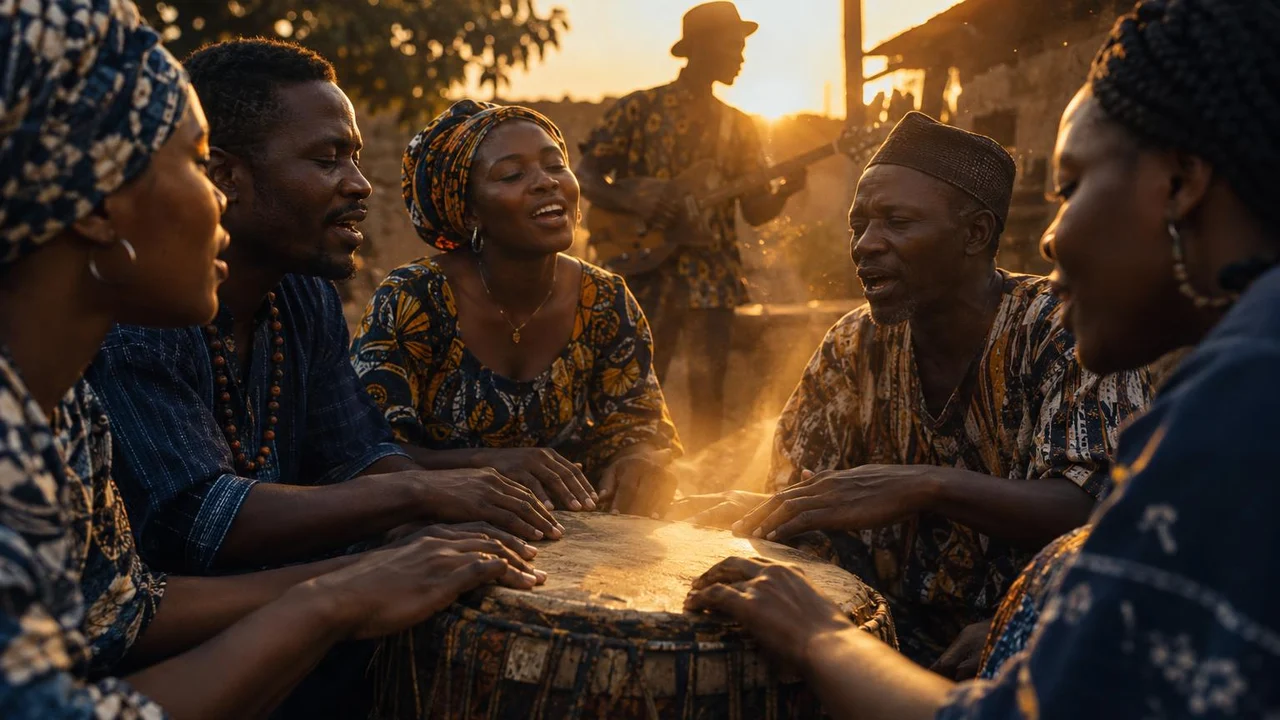
Rhythm and bodily motion
At 108 BPM the pulse is steady but elastic. Short motifs repeat and interlock instead of lining up on a single downbeat, and that Fon polyrhythm becomes the engine that turns the piece. Voices enter in succession, like spokes joining a wheel: each phrase arrives, circles, and leaves space for the next, producing a constant sense of rotation.
Physically the track asks for compact, continuous movement. Hips and shoulders sway to one layer while feet and claps answer another; hands can lock onto a repeating motif as the torso follows a slower sweep. The music wants bodies to carry multiple pulses at once, so the motion you find is communal — a shared cadence rather than a solo gesture.
Percussion and guitar textures
Organic percussion
Percussion sounds immediate and hand-driven, with attack and decay that feel tactile. Those drums and shakers trace the polyrhythmic skeleton, punctuating the choir lines and filling the midrange with rhythmic punctuation. Because the percussion emphasizes natural timbres, the canon of voices never floats free: it always has a gripping, physical backbone.
Highlife guitar
A highlife-style guitar sits in the mix with short, bright phrases that shimmer rather than dominate. Its role is propulsion and harmonic glue — repetitive figures that orient the ear within the rotating vocal architecture. The guitar interlocks with the percussion and choirs, reinforcing the forward motion without displacing the rotary pulse.
Language as vocal instrument
Languages are deployed as musical textures. French carries the longer verses and shapes extended melodic lines; English functions as the recurring communal refrain that voices return to; Fongbé supplies short response lines that punctuate and animate the call‑and‑response flow.
Because the choirs sing in canon, those language shifts become musical events: syllabic rhythms and vowel colors fold into the polyrhythmic pattern, so French, English and Fongbé act as both meaning and percussive timbre. The result is a multilingual conversation where sound, timing and consonant attack matter as much as semantics.
Region and tradition in feel
The arrangement channels rhythmic logic associated with Benin. The circulating polyrhythms and use of Fongbé connect the piece to southern West African rhythmic practice, where interlocking patterns and communal singing are central. The highlife-inflected guitar points to regional crosscurrents in which danceable guitar lines meet collective vocal structures.
This is not a pastiche: it positions traditional Fon rhythmic thinking inside a contemporary band texture, keeping ritual-derived timing and communal phrasing intact while allowing modern instruments to articulate them.
Energy and communal voice
Descriptors that fit the track — deep, warm, federating, elegant, progressively exaltant — reflect how the music grows. It starts as intimate group warmth and accumulates into a larger collective lift as more voices and motifs layer in.
The circular choir architecture is inclusive by design: it sounds made for gatherings where many people hold space together rather than for spotlight solos. Listeners who enjoy layered vocal interplay, hypnotic polyrhythms and the tactile mix of organic percussion plus highlife guitar will find the track keeps revealing new locked grooves on repeat.
Fon polyrhythm Afro-Soul
Fon polyrhythm Afro-Soul places Fon rhythmic logic into a contemporary Afro‑soul setting and occupies a clear place in West African rhythmic practice where communal drumming and singing shape movement. This track foregrounds Fon polyrhythm, pairing layered circular choirs with organic percussion, highlife guitar and multilingual call‑and‑response.
Origins and development
Fon polyrhythm comes from the Fon people of Benin and the wider southern West African polyrhythmic tradition. Interlocking drum patterns and communal singing developed within religious and social ceremonies and later informed popular regional musics, carrying an emphasis on overlapping, cyclic phrasing.
Defining musical traits
Tempo here is 108 BPM. Rhythmic life is built from short, interlocking motifs rather than alignment on a single downbeat; overlapping pulses create a rotary sensation. Percussion is organic and hand‑driven, providing tactile midrange detail. Voices function as circular choirs in canon, using call‑and‑response and close, soulful harmonies. Typical timbres include hand percussion, highlife‑inflected guitar and layered vocal parts.
How this track uses the style
The track plants Fon polyrhythm at the centre: choirs enter in succession, forming a canon that intensifies a rotating pulse. Organic percussion traces the polyrhythmic skeleton while a shimmering highlife guitar supplies short, repetitive figures that lock with the percussion and choir. Language becomes musical texture: French carries the longer verses, English supplies the recurring communal refrain and Fongbé provides short response lines, their syllables folding into the rhythmic web. The result asks for small, continuous bodily movements as different limbs answer different pulses.
Styles to explore next
Highlife; Ewe drumming