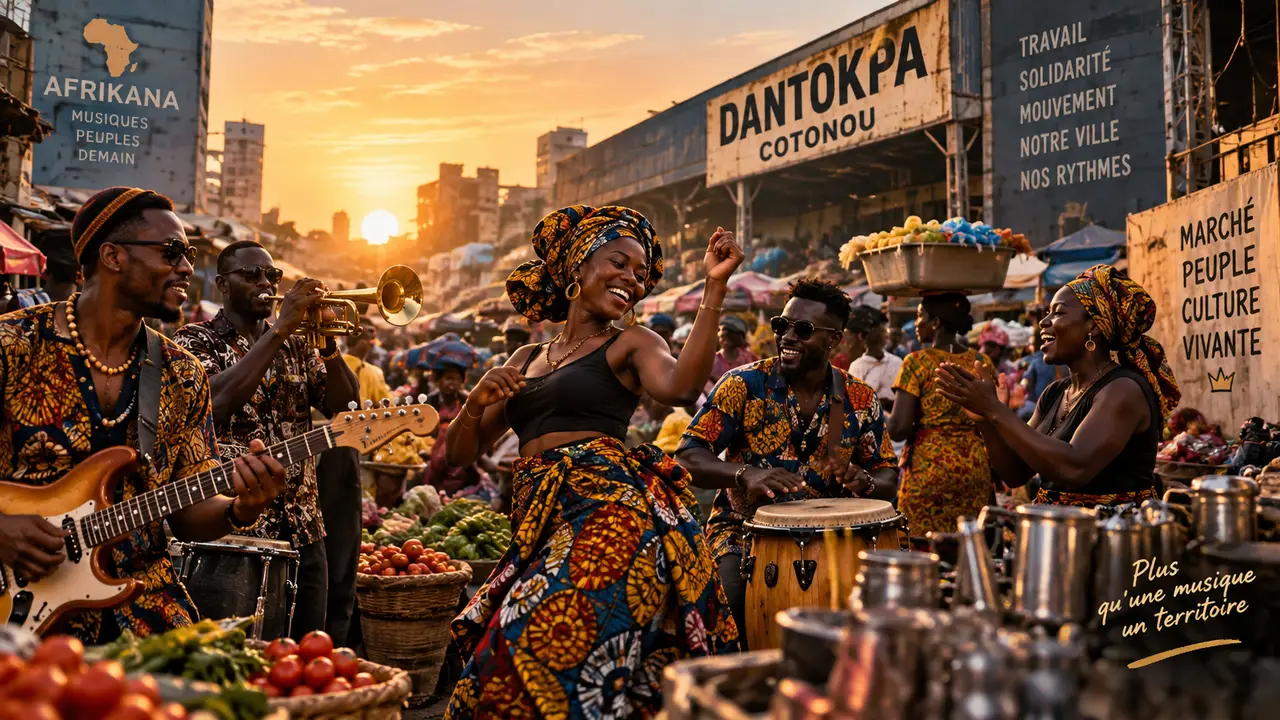
Rhythm that moves the body
The pulse is immediate and physical: interlocked grooves sit in a locked pocket that invites feet, hips and hands to fall in. Rhythmic patterns are steady rather than frantic, with syncopated accents that push dancers forward rather than pulling them back. Repetition becomes momentum — short cycles that make it easy to join in and to map movement across a busy market day.
Percussive textures are often brittle and metallic, which keeps the beat both crisp and urgent; those sharp sounds cut through the low-end of bass and guitar so the body always finds a clear place to land.
Guitars, brass and metallic percussion
Guitar as forward motion
A looping, Highlife-inspired guitar fills the space between rhythm and melody. Its melodic lines weave steady arpeggios and short phrases that provide harmonic warmth and a directional feel: the guitar keeps the music moving forward, offering a repeated motif listeners can sing against or dance to.
Brass and metallic color
Brass enters with bright, staccato motifs that act like punctuation — callouts that slice through the mix and cue shifts in energy. Metallic percussion (shakers, scraped metal, tuned strike plates) layers a tactile sheen over the groove: these sounds evoke tools and surfaces you might hear in a market, giving the arrangement an audible link to place.
Each element has a role: guitar for continuity, brass for cues and communal moments, metallic percussion for texture and the sense of place.
Fongbé call-and-response as rhythm
Fongbé functions as a rhythmic instrument. Hooks and group responses are composed of short, punched phrases and shouted refrains that sit in the same rhythmic pocket as the drums and guitar. Those vocal fragments become percussive glue — they lock in with the beat and invite others to answer.
When English lines appear, they frame the narrative for broader listeners, but the Fongbé hooks remain the song’s heartbeat. The result is a bilingual balance: English offers context while Fongbé supplies the call-and-response muscle that turns listening into participation.
Market life and social choreography
The music compresses the movements of market labor into sonic form: bargaining, carrying loads, calling prices and the constant flow of bodies. Structural choices mirror market interactions — repeated motifs suggest the rhythm of walking a stall row, brass calls echo the sudden urgency of a buyer’s shout, and metallic breaks mimic the clatter of goods.
Themes that come through are practical and communal: work, negotiation, mutual aid and the fatigue that comes with a long day. Instrumental passages function like snapshots of the market: a brass burst sketches a crowded thoroughfare; a guitar riff suggests the steady trudge between stalls.
Energy and who it is for
This music is designed for collective engagement. It lives where people already gather — markets, street corners, local dances, radio and informal social spaces — and it translates easily to an audience that wants to move, clap or sing back. The call-and-response format hands agency to listeners; participation is encouraged rather than optional.
Whether heard amid the bustle of a marketplace or through a speaker at home, the track asks for a bodily answer: step in, respond, keep the rhythm going.
Beninese Afro-Funk
Beninese Afro-Funk sits in West African popular music as a hybrid that joins Highlife guitar sensibilities with funk’s rhythmic drive, grounded in the everyday soundscape of Cotonou. It foregrounds communal performance practices and market rhythms as central musical material.
Origins and development
The style grew from West African popular currents that absorbed Ghanaian Highlife guitar phrasing and the syncopated groove aesthetic of funk. In Benin and nearby coastal scenes musicians layered brass and local percussion textures onto those frameworks to suit public, communal contexts such as markets and street gatherings.
Defining sonic traits
Typically mid‑tempo (roughly 100–120 BPM), the music relies on tightly interlocked drum grooves and a bass that locks with the kit to propel dancers. Guitar plays looping, Highlife‑inspired melodic lines; brass supplies short, bright motifs and punctuation. Vocals use call‑and‑response, with shouted refrains that function rhythmically. Metallic percussion—shakers, scraped metal and struck plates—adds a brittle, textural sheen.
How this track fits
This recording layers Afro‑Funk rhythms with Highlife‑style guitar loops, bright brass answers and metallic percussive textures to evoke market activity. Fongbé appears as rhythmic hooks and group responses, turning language into percussive glue; occasional English lines frame the story while the Fongbé refrains keep the local pulse.
Next styles to explore
Highlife
Afrobeat