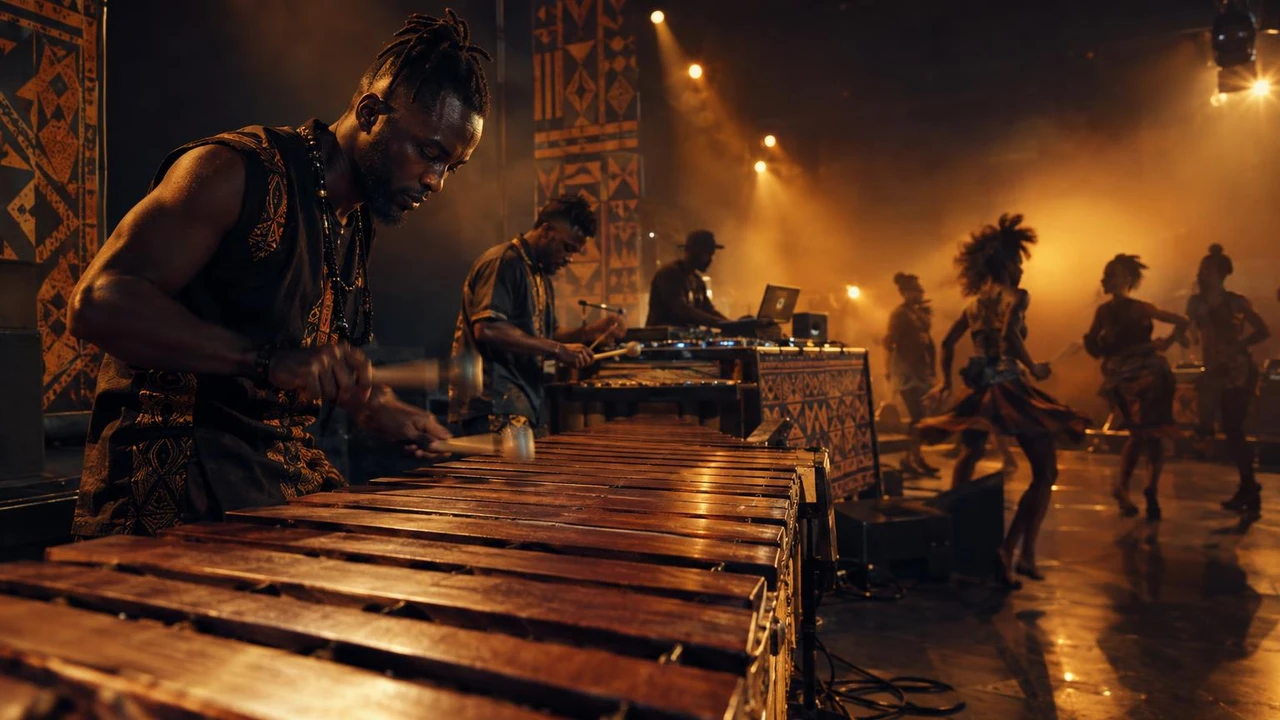
Rhythm and bodily movement
Bwera kuno moves on a steady, cyclical insistence that asks the body to keep up. Patterns unfold in loops rather than long melodies: short percussive figures stack and repeat, nudging the listener into trance-like motion. The pulse reads as athletic — compact, syncopated hits that invite stepping, shuffling, and quick, competitive exchanges on the dancefloor.
The track uses space as much as sound. Repeating motifs leave room for breaths, small vocal callouts, and the echo of hand percussion, so movement can respond to silence as readily as to sound. That give-and-take creates a physical conversation: dancers answer the music the way singers answer each other.
Instruments: marimba and percussion
Marimba wood groove
The marimba sits at the heart of the arrangement. Its wooden plucks are presented with an almost live intimacy: resonant, slightly hollow attacks that carry harmonic color without crowding the low end. Those plucked timbres provide the melodic anchors — short riffed figures that recur and mutate, lending the track a warm, earthy center.
Deep tribal bass and hand percussion
Below the marimba a dense tribal bass anchors the sound. It’s not just low frequency weight but a physical presence that gives the music its grounding and urgency. Layered hand percussion and tight, clipped electronic hits create the forward momentum, keeping rhythms crisp while the bass provides weight for bodies to lean into.
Language: Chichewa’s sound and message
Sung in Chichewa, the vocals are spare and emphatic. The hook — a daring line that translates as “Stronger than you? Prove it.” — lands as a taunt and an invitation at once. Phonetic choices and rhythmic phrasing make the language part of the percussion: short, punctuated syllables that sit with the marimba and percussion rather than float above them.
The interplay between teasing lines and declarative responses gives the track a competitive conversational tone, one that naturally suits call-and-response settings and group participation.
Region and tradition: Malawi roots
The music draws directly from Malawi-rooted traditions while speaking in contemporary club textures. Wood-based melodic instruments like the marimba connect to regional instrumental practices, and the communal dynamics of the track — callouts, short refrains, and danceable cycles — reflect performance contexts where music and social interaction are inseparable.
AFRIKANA’s video release for the single pairs those musical elements with visual cues that emphasize communal dance and traditional motifs, aligning imagery with the track’s rhythmic character.
Energy and the intended crowd
Bwera kuno is designed for movement and assertion. Its mood reads proud, teasing, and powerful: a track for dancers who want to show stamina, for crowds that answer back, and for spaces that value communal participation over passive listening.
Listeners will find it useful in sets that aim to provoke physical response — club moments, dance workshops, or community gatherings where challenge and celebration coexist. The Heart of Africa app features the track alongside contextual notes and video links, making it easy to save, share, and explore the social practices that surround this sound.
Chichewa Afrohouse
Chichewa Afrohouse names a strand of Afrohouse that foregrounds Chichewa-language singing inside contemporary African dance production. It occupies a localized place in pan‑African house currents, bringing Malawi‑rooted melodic and percussive textures into the club and community sphere.
Origins and development
Afrohouse grew from the cross‑pollination of global house music with African rhythmic traditions; in southern and central Africa producers and players folded local percussion and melodic instruments into four‑on‑the‑floor frameworks. Chichewa Afrohouse specifically anchors that template in Malawi’s Chichewa‑speaking communities, adapting indigenous marimba and hand‑percussion practice to a dancefloor context.
Defining musical traits
Typical tempos sit roughly between 110–125 BPM, with a steady kick pulse layered under syncopated, polyrhythmic percussion. Bass is deep and rolling, designed as a low‑end drive rather than melodic lead. Vocals are often rhythmic, chantable and call‑and‑response in approach. Common timbres include acoustic marimba or wooden tuned percussion, layered hand drums, electric bass and sparse synth pads.
How this track fits
This recording pairs live‑sounding marimba plucks and a marimba wood groove with a resonant, tribal low end. Arrangement relies on cyclical motifs and layered hand percussion to build a hypnotic, athletic pulse; production keeps a tight low‑frequency drive. Vocals in Chichewa trade teasing, athletic hook lines with proud declarative phrases that function as a communal dare to move.
Next styles to explore
Tribal House
Amapiano